The Actual Layering Logic Fall Weather Requires (That Summer and Winter Dressing Don't)
Quick Answer: Fall dressing needs its own logic because the daily temperature swing between morning and midday is wider than summer or winter typically produce. The fix is building outfits around a base layer suited to the warmer midday temperature, plus one easily removable mid-layer — a cardigan, an open shirt, an unstructured jacket — instead of stacking several bulkier layers.
Fall dressing gets approached as simply a lighter version of winter layering, but that’s the wrong mental model. Fall weather’s actual defining characteristic — a considerably wider temperature swing between morning and midday than either summer or deep winter typically produces — genuinely demands its own specific layering logic rather than a scaled-down winter approach.

Why Does Fall Weather Need a Different Layering Approach Than Summer or Winter?
Summer dressing rarely needs to accommodate a large temperature swing within one day — it’s warm in the morning and warm at noon. Deep winter dressing generally stays cold enough that a consistent, heavier layering approach works from morning through evening without much adjustment.
Fall breaks both of those patterns. A genuinely cold morning gives way to a noticeably warmer midday, which then cools back down into a crisp evening — all within the same day. Neither the single-layer summer approach nor the consistently heavy winter approach actually accommodates that swing. Dress for the cold morning and you’re overheating by 1pm; dress for the warm midday and you’re shivering at the bus stop at 8am.

What’s the Actual Fix for Fall’s Temperature Swing?
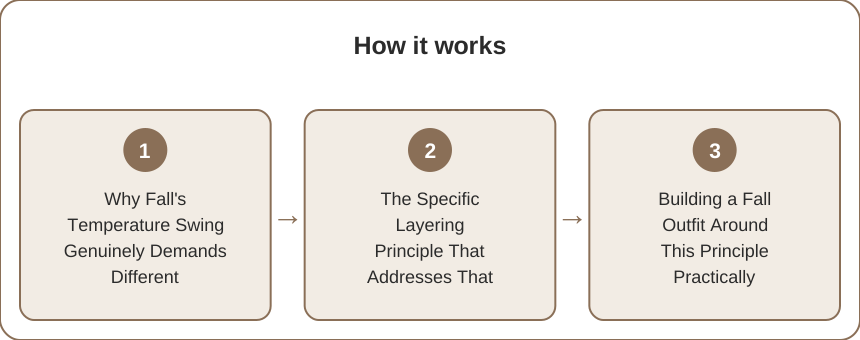
Build the outfit around one easily removable mid-layer — a cardigan, an unstructured jacket, an oversized shirt worn open — that can come off entirely at midday and go back on in the evening. This beats both extremes: a single fixed outfit that ignores the swing entirely, and several bulkier layers that are genuinely harder to add and remove throughout the day when you’re not near a bag to stash them in.
The mid-layer is doing one specific job: absorbing the temperature difference between the day’s coldest and warmest hours, in a single piece you can put on or take off in seconds.
How Do I Build a Fall Outfit Around This Principle?
- Choose your base layer for the warmer midday temperature — this is the piece you’ll be wearing regardless of the hour, so it should be comfortable at the day’s warmest point, not its coldest
- Add one easily removable mid-layer on top — sized and styled so it comes off cleanly without disrupting the outfit underneath
- Skip the third and fourth layer — this two-part structure (base plus one mid-layer) keeps the outfit genuinely adjustable; three or four heavier stacked layers become a hassle to manage across a swing, not a solution to it
What Nobody Tells You About Fall Layering
- The mistake isn’t wearing too little or too much — it’s picking layers that can’t come off easily. A bulky, hard-to-pack third layer defeats the purpose even if the temperature math is technically right.
- Your base layer choice matters more than your outer layer. Since the base stays on all day, it needs to be comfortable at the warmest point of the swing — the mid-layer is what compensates for the cold edges.
- A structured blazer is a worse mid-layer than an unstructured cardigan, even though it might look sharper — structure makes a piece harder to remove quickly and awkward to carry once it’s off.
- The “layer for the coldest part of the day” instinct is the single most common fall dressing mistake — it solves the morning and creates an overheated midday, which the two-part structure specifically avoids.
Fall Layering FAQ
What’s the difference between fall layering and winter layering?
Winter layering assumes consistent cold throughout the day, so heavier, more numerous layers stay on from morning to night without much adjustment. Fall layering assumes a wide swing within a single day, so the structure is built around one removable piece rather than a fixed stack.
What kind of mid-layer works best for fall’s temperature swing?
Something you can remove in seconds without disrupting the outfit — a cardigan, an open button-up worn as a layer, or an unstructured jacket. Structured pieces like blazers work less well because they’re less comfortable to carry once removed.
Should I just wear a heavy coat in fall and skip the layering logic entirely?
That solves the cold morning but leaves you overheated and stuck carrying a bulky coat by midday, which is exactly the problem this layering logic is designed to avoid. A base layer plus one removable mid-layer stays comfortable across the whole swing instead of just one part of it.
TL;DR:
- Fall’s daily temperature swing is wider than summer’s or winter’s — that’s what makes it different
- The fix: a base layer suited to the warm midday, plus one easily removable mid-layer
- Skip three or four stacked layers — they’re harder to add and remove throughout the day
- Choose an unstructured mid-layer (cardigan, open shirt) over something structured like a blazer
- Dressing for the coldest part of the day is the most common fall layering mistake
Fall weather’s genuinely wide daily temperature swing between morning and midday demands its own layering logic rather than a lighter version of winter dressing, and building an outfit around a base layer suited to the warmer midday temperature plus one easily removable mid-layer — rather than several bulkier stacked layers — keeps the outfit comfortable and adjustable across that entire daily swing instead of being too warm at midday or too cold at the edges of the day.
Keep Reading
This article is for general styling and informational purposes only. Trends, sizing, availability and pricing may vary by brand and season.